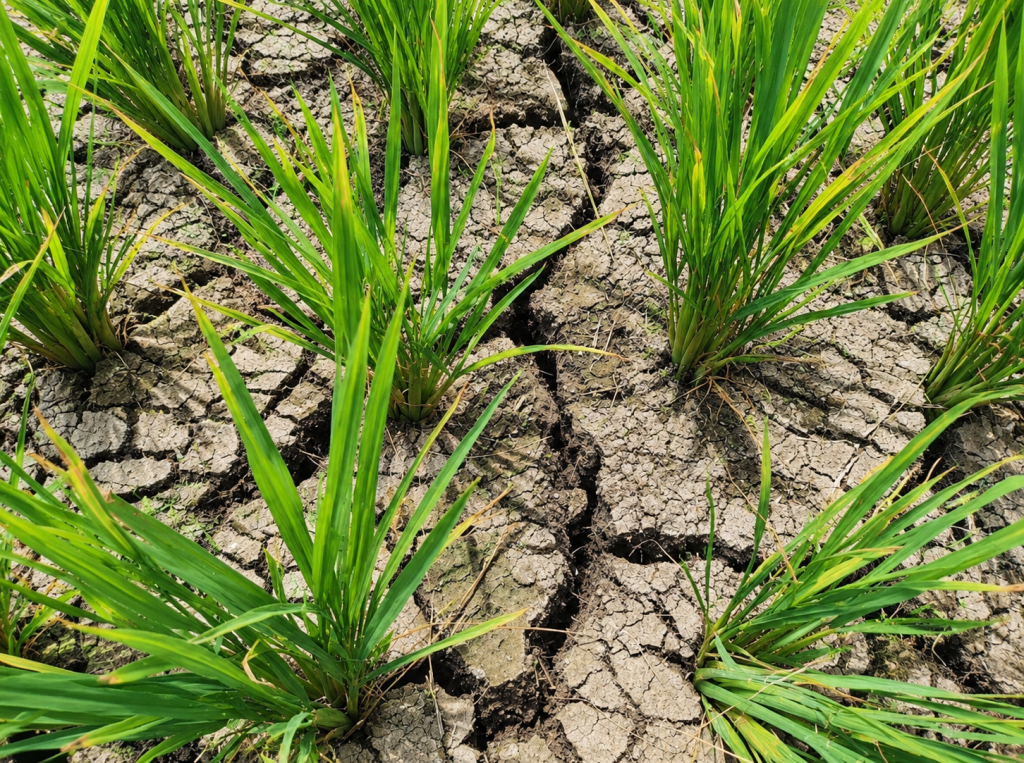
Photo courtesy of Inopacan Municipal Agriculture Office
There is a kind of silence that comes when the rain does not.
The afternoons become harder to bear. The soil begins to harden and crack. The canals carry less water. The rivers dry up. And farmers begin to wonder when the next rain will come.
For many of us, a hot day means finding shade or turning on a fan. For farmers, these changes mean more than uncomfortable weather. It can decide whether a family earns enough to get by, whether a loan can be paid, and whether there will be enough to plant again.
This is the difficult reality of El Niño.
And this 2026, the Philippines is experiencing that difficulty again.
According to PAGASA, a strong El Niño is now present in the Tropical Pacific and expects the phenomenon to be very strong and to continue into the first half of 2027, with the possibility of reaching its peak before the end of 2026. PAGASA has urged early preparation because the effects could mean prolonged heat and reduced rainfall.
We cannot tell the rain when to come. But we can no longer afford to ignore what happens when it doesn’t.
A Season of Waiting
A farmer cannot plant with rain alone. There must be water for the seed to grow, water for the rice to survive the heat, and enough water to carry the crop through the weeks when the sky refuses to cooperate.
Rice needs enough water to grow properly. Without a reliable supply, farmers may have to delay planting, reduce the size of their fields, or find crops better suited to dry conditions. Some may have to spend more to get water to their land, while others have to wait.
But waiting is not always an easy decision to make.
The bills do not wait. The family’s needs do not wait. The money borrowed for seeds, fertilizer, and other expenses still has to be paid back.
And if the harvest fails, a farmer does not lose only the crops. He may also lose the money needed to begin again.
When we talk about El Niño, we are talking about more than the absence of rain. We are talking about people’s livelihoods, their security, and the difficult choices they may have to make.
Preparing Before the Damage is Done
This time, the government is trying to move earlier.
The Department of Agriculture (DA) has been promoting climate-resilient farming practices, drought-tolerant crops, and adjustments to planting schedules. The Philippine Rice Research Institute( PhilRice) has also provided guidance on rice varieties and farming practices suited to different water conditions.
The National Irrigation Administration (NIA) is preparing to use groundwater maps to identify potential water sources for solar-powered pumps. The agency is also increasing maintenance and rehabilitation of existing irrigation systems, preparing mobile solar pumps for drought-prone areas, and clearing and desilting canals to make sure the available water can move more efficiently.
There is also a larger push to improve irrigation across the country, with over P63 billion allocated for irrigation programs in 2026, covering rehabilitation, improvement and expansion.
But perhaps the most meaningful part of irrigation work is not the number attached to a program, but the water that finally reaches a field. It is a farmer who can plant because an irrigation canal is working. It is a crop that survives another week of heat.
Pampanga is preparing too.
For those of us who know the fields of Pampanga, this is a problem that is not abstract. The province is already looking ahead.
On October 6, the Pampanga provincial government, NIA, DA, the Office of the Provincial Agriculturist, farmers and irrigators associations met to discuss longer-term ways of protecting agricultural water supplies.
Among the ideas being studied are water impounding facilities, lakes and water-retention areas that can retain water during the rainy months and provide a source for irrigation when El Niño arrives.
The province is also pushing to expand solar-powered irrigation and is targeting 50 solar-powered irrigation units by 2027, in coordination with NIA and DA.
I think this is very important because preparing for drought is not only about finding water when everything is already dry. Sometimes, it means saving water while we still have it.
Pampanga is also considering the creation of an El Niño Task Force to coordinate preparations for communities, agriculture, water resources and livelihoods. The province has brought together agencies including PAGASA, NIA, DENR, DPWH, DOH and others to discuss the possible effects of prolonged dry conditions.
It is the kind of preparation that may not make headlines when the sky is still partly cloudy. But perhaps that is exactly the point.
The best time to prepare for an empty canal is while there is still water in it.
The Response is Becoming More Local
Across the country, preparations are taking different forms.
In Cagayan, NIA is working with farmers and irrigators on water management and dry-season cropping schedules.
In Cotabato, NIA is using solar-powered pumps and is carrying out repairs, desilting and water scheduling to protect available irrigation water.
In Isabela, provincial officials and national agencies are coordinating plans around agriculture, water security and vulnerable communities.
In other areas, local governments are preparing drought contingency plans and urging residents to conserve water before shortages become more serious.
The approach is different from simply waiting for a disaster and responding afterwards. And perhaps that is one of the biggest lessons El Niño is forcing us to learn.
Preparation is harder than recovery, but it is often kinder.
It is easier to repair a pump than to replace an entire lost harvest. Easier to save water than to search for it when every household needs it at the same time. Easier to prepare farmers before planting than to help them after a field has already failed.
But this is not only about agriculture. El Niño does not stop at the edge of a ricefield.
Long periods of heat and reduced rainfall can affect water supply, electricity, health, forests and livelihoods.
The Department of Health (DOH) has been strengthening its information campaign on heat-related risks and is asking communities to avoid prolonged exposure to direct sunlight, stay hydrated and take breaks when working outdoors. Health authorities are also monitoring for possible water- and vector-borne diseases.
DENR, meanwhile, is preparing for greater water stress and an increased risk of forest fires during prolonged dry conditions.
And the President has directed government agencies to provide accurate, timely and science-based information about El Niño, especially as the country enters the months when its effects could become more noticeable.
Because during a crisis, information matters too. People need to know when to conserve. Farmers need to know when to plant. Communities need to know where water may come from. And families need to know how to protect themselves from the heat.
What Can Ordinary People Do?
It is easy to think that El Niño is too big for an ordinary person to do anything about.
But it isn’t.
We may not control the weather. But we can control how much water we waste.
☑️Turn off the faucet while brushing your teeth.
☑️Repair leaking pipes.
☑️Reuse water when it is safe to do so.
☑️Water plants early in the morning or later in the afternoon instead of during the hottest part of the day.
☑️Do not leave hoses running unnecessarily.
☑️Bring water when going outside, especially during periods of extreme heat.
☑️And most importantly, listen to reliable weather and government advisories rather than rumors spreading online.
These things seem small. But millions of small habits become something much bigger.
When the Rain Does Not Come
Today, science gives us forecasts that our grandparents did not have. We have satellites, climate models, irrigation systems, solar pumps and early-warning systems. But even with all these tools, one truth remains: We still depend on water. And when the rain begins to disappear, we are reminded just how much.
Maybe that is why preparation matters. Not because it can stop El Niño. It definitely cannot. But because preparation can give a farmer another chance. A working irrigation pump. A stored supply of water. A drought-resistant seed. A little help with fuel or fertilizer. A government that arrives before the crisis becomes impossible. And a community that understands that water is not something we can afford to waste.
The rain will eventually return. Until then, the fields will wait.But we should not wait with them.
Because for a farmer, rain is never just rain.
Sometimes, it is a family’s next meal.
Another season of work.
And the hope of beginning again.
Sources:
1. “PAGASA – El Niño Advisories and Monitoring”
2. “PAGASA — El Niño Monitoring”
3. “Philippine Information Agency – PAGASA urges early action amid very strong El Niño”
4. “Department of Agriculture – DA braces for intensified El Niño”
5. “Presidential Communications Office – Government preparations for Super El Niño”
6. “Philippine Information Agency – NIA and farmers strengthen water management”
7. “SunStar Pampanga – Capitol eyes measures for agricultural water supply”
8. “SunStar Pampanga – Pampanga prepares El Niño Task Force”
9. “Philippine Information Agency – NFA ordered to increase palay procurement and rice stocks”


Leave a Reply